

How Do You Draw A Robot
Sometimes we need to put a robot in our sci-fi theme artwork, just you do non usually describe robotic or mechanical things. In this tutorial, I will evidence you an easy manner of designing a humanoid robot and drawing with prune studio ruler tools.
Process Overview
Video Tutorial
The basic concept of a humanoid robot design
There are several things that you need to know earlier designing a humanoid robot.
Hither are the three main keys for starting your design.
>>Figure design
The humanoid robot is a robot that has a frame like a human torso. Its primary composites are body parts and joints.
When turning it to robot parts, depict it every bit boxes.
By adjusting the box parts, yous tin easily design the robot calibration.
For case :
If you lot are going to blueprint a robot that looks like it belongs in the forepart lines, make the chest and arms bigger to smack the enemy with or to carry a weapon with.
Or thinner and smaller trunk for a robot working in a laboratory so it tin can move freely in limited space.
Or a bigger head for a cuter robot that contains a lot of information :D
You tin likewise adjust parts and joints positions to create a more unique style.
Note: yous have to give more than attention to the robot'south movement when reducing some joints if you lot demand to make a more realistic looking robot. For case, the robot can't walk correctly if yous remove its human knee joints. You may add some wheel or power engine at its feet to bladder.
>>Body parts
Mainly the robot parts are a solid shell that covers the robot mechanical insides. And so its shapes can be whatsoever you experience similar to fit the design, such as boxes or cylinders.
You lot tin also put the parts without shells merely instead with a skeleton structure.
>>Joints
For the robot design, you can detect some references to mechanical joints to design your own type of joints, hither are some examples of joints.
In some parts such every bit the spine it may need continuous articulation parts.
Or covering for protection, such as shoulder parts or elbows.
Note that in that location's also some limitations to the movement of each joint. (except the 'no joint', it is futuristic engineering science no one knows what it's going to be, so you can put anything you want)
Also note that the more than realistic you make the joints, the more realistic your robot will exist!
Working on design
In this part I will show you the process of designing a humanoid robot and draw it out with Clip studio.
>>Design the parts
Programme the robot body effigy and so add some simple joints
Usually, the robot's body is symmetrical for the residuum in movements, just you lot can likewise pattern not-symmetrical robot's as well, there is no strict rule on that :D
And then apply the Symmetrical ruler to draw the details.
Select the menu 'Symmetrical ruler' in the ruler subtool, then adjust [Number of lines] to two and have the [Line Symmetrical] checked.
Drag the line on the middle torso of the robot, hold [Shift push button] to arrive perfectly vertical-marshal to the image.
Bank check on the pick [Show in all layers] in the layer console, this volition allow it to appear on all the layers.
Now you tin can depict on one side and it will appear on the other side.
I apply elementary pen for the shape sketch
Get-go past drawing the rough shape of the robot, then apply the details later.
Tips: when working with the Symmetrical ruler, you can't use the eraser tool to erase on both sides.
Apply transparent color instead! You can select it below the color panel and pigment with your current brush.
Now it's possible to erase on both sides!
Optional: depict the side designs for a clearer prototype to your design
Tip: put the line projected from the front view to easily command the scale of the sketch.
>>Draw it in perspective
If you're e'er messing with the perspective( similar me =w= ), learning how to use [Perspective Ruler] volition change your life forever!
Nevertheless, you likewise demand to larn some nuts of how the perspective takes consequence in the drawing.
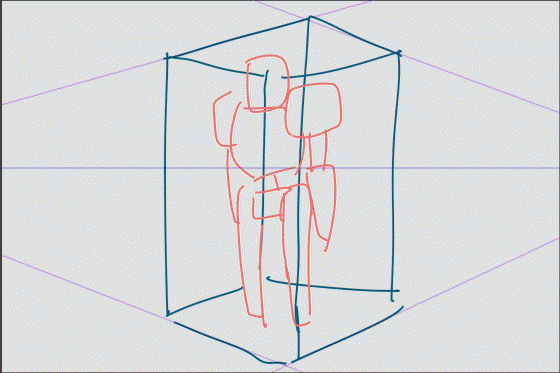
Information technology is just like looking at an object in a box. Imagine a box covering an object.
When you lot elevate the projection line from the box, it volition add vanish points somewhere. (information technology may stay exterior of the image don't worry about it)
When you draw the box, cover the object. You will understand more than most perspective, you can give it a endeavor on whatsoever prototype of some object. Take a photo with your phone and practice.
(Note: using a polygon shaped object will be easier than a curved object.)
Select the perspective ruler at [Add vanish point] process, then drag the ruler to the vanishing point of the box.
You must drag another line to commit the perspective ruler
Clip studio will automatically add the horizon line (and ruler on the layer) for the perspective ruler.
Draw some other perspective ruler for some other vanishing point, and you're done with the ruler.
Simplify the shape of the design and place on the sheet with the perspective ruler.
Transform the image : Edit > Transform > Free Transform [CTRL+SHIFT+T]
Set up the mode to [Complimentary Transform]
So motion the corner of the transform box to fit the ruler at one side.
Create a new vector layer for the box sketching
I recommend using the 'fill up-in-mono pen' to depict the box because information technology will give the pen no pressure as if you lot're drawing a blueprint.
I dearest to start with the anxiety because they're the nearest to the ground line nosotros fabricated.
In eraser belongings, you can find the [Vector Eraser] selection that makes information technology easy to piece of work with the unwanted lines.
Draw the more than box by using the sketch as a reference to project the line.
Then draw another line to complete the boxes. The perspective ruler makes this process very easy!
Clean up unwanted lines each time the part is finished.
Tips: use dissimilar colors to make drawing easier, these box shapes are only for cartoon references, don't worry if they are not perfect.
Disabled the snap to ruler
Draw the parts in the reference box, this will make it easier to manage the perspective of the robot.
Describe the parts before adding the joints.
As well, use dissimilar colors to avoid confusion.
When it's done, change the ink color to the same color
(lock the layer transparent and then fill with colour)
>>Inking process
For the inking process, I just describe with the 'Bezier Curve tool' which is located in 'Figure Sub tool'
Create a new vector layer, the bezier line is only editable on the vector layer.
And describe it on the sketch we fabricated
Controls for Bezier curve tool:
Click = brand corner node (foursquare node)
Click, concur and elevate = make a curve (circle node)
Double Click = terminate the line
Both nodes have arms control then that y'all can pull to adjust the curve of the line that is connected to the node.
For more than details nigh the Bezier Curve tool, check my previous tutorial on working with it.
Notation that at that place will be some parts that testify the thickness of the parts, brand sure you also draw those.
Use the vector eraser to clean upwardly the overlapped role for each function finished, this volition assistance avert defoliation.
You tin can likewise edit the line by using the 'Control point tool' in 'Right line' subtool
Information technology'south useful to edit parallel curves for part thickness
Finished ink piece of work.
>>Coloring
Coloring the mechanical parts is easy.
Imagine how the box takes consequence with the light.
Create a raster layer below the ink vector layer
Draw the line for shading with greyness color, utilise the box for reference.
And so fill up the color with the 'Fill tool'
Besides add shadows to the parts that overlap.
At present the robot will look more than dimensional.
You can also change the ink color with the object tool
To fill up the base color, set up the ink vector layer to [Reference Layer]
And in the fill tool, set the Refer multiple to [Reference Layer]
Fill the color in the layer beneath the shadow, the color volition likewise fill without taking consequence from the shadow layer.
(lower the shadow layer's opacity to see it transparent)
Fill all the color,
And so change the layer style of shadow layer, to make it blend together with the robot.
(I e'er employ [Linear burn], merely you lot can choose whichever fits your art mode more)
Adjust the opacity downwardly until the result are adept for you.
There volition exist some parts that appear under the robot's shell. Fill it with a darker shade of the parts color.
When you are done with the colour fill, make a folder to put information technology in for easier direction.
Optional: I use the 'Mistiness tool' to soften the shadow border a fleck on some parts.
And pigment additional shadows with the same greyness color used in the shadow layer.
Clipping the shadow layer with the color folder will permit information technology to show on colored areas only.
Earlier
After
(the overflow gray is gone)
You can also clip many layers in instance you have a lot of shadow layers.
For the highlight, create a clipping layer to part color.
And paint with the soft airbrush
(I really love this process because it's like we're doing the coloring of a toy model.^ due west ^/)
On pointy corners, to make it pop up, erase some of the airbrush color on one side of the area
So blend it with the blur tool to give information technology a more dimensional expect.
Also boosted shadows on some parts.
To give it a metallic await to some parts, add the bold highlight effect at the about pointy areas.
To make the robot look shinier,
create a new layer above the ink layer and apply highlights to the borders with a pencil tool and lighter color.
For highlighting the edge areas, hold [Shift] button to drag the straight line
Also give some highlight to pinnacle edge of thickness edge.
Big highlighting will give it a shinier look!
finish!
>>Additional customizations
Nosotros may add some details to enchant the robot's looks, such every bit painting, some dirt and low-cal
For the painting: Blazon the numeric lawmaking, or import some logo.
If it'southward typing, rasterize the layer.
Then use the free transform fashion [Ctrl+T] to adjust it to the surface.
And paint on with the textured airbrush with transparency on the border to make it look like ruined painted.
Y'all can also add together dirt effect with the texture airbrush and blur tool
And accommodate the layer blending mode for a more neutral await (here I used color burn style)
Optional: Paint scratches and use the textured airbrush ruin the color.
For the spotlights: draw the light from the light bulbs with the colour you prefer.
So paint the dark light(in blue) with [Color burn down] layer mode.
And [Add(Grow)] layer mode and pigment again to brand the light event.
Tip: add together the highlight border to brand some parts that have like colors look separated.
Cease!
Now yous can bring the robot to your scene!
(Annotation : the background here is mix of clip studio image materials)
I promise this tutorial give you some ideas for working with perspective and cartoon an easy humanoid robot pattern with useful tools from clip studio ^ due west ^
[Artist's side note]
I accept studied well-nigh robots in my engineer class at the academy and my first chore. So I actually made some robot hardware in real life but I am always not practiced at cartoon information technology. However, since I know the perspective ruler tool, I constitute the auto is very easy to draw with the tool!!

Source: https://tips.clip-studio.com/en-us/articles/3736
Posted by: garciajacessid.blogspot.com
0 Response to "How Do You Draw A Robot"
Post a Comment