

How Do Koreans Feel About Guys Wearing Makeup

Why K-Popular has Korean Men Wearing Makeup
Traditional masculine ideals in South korea are being redefined by cultural, social, and economical forces
H ere's a novel stat: South korea accounts for about 20% of the world market place for men's cosmetics. This means annual sales of more than $1 billion courtesy of a mere 25 million men, and this figure will inflate by 50% over the next 5 years. On a per capita level, Korean men have everyone beat. Why? Considering "appearance is ability" and "youth equals power."
Nosotros're not just talking pare lotions or aftershave here. Korean urbanites are also smitten with BB Foam, brow pencils and guyliner. Girlfriends and spouses not only shop cosmetics for their male partners in Seoul, but also casually apply lipstick to their faces in public without anyone sharpening the proverbial pitchforks.
That said, shouldn't gender-bending be a complete no-no in the securely Confucian culture of Korea? As well, conforming its two years of mandatory military service for young men, shouldn't Korea's benchmark for masculine dazzler be the hardy, rugged type? Similar Clark Gable? Even Bruce Lee? While that was once true, Due south Koreans now prize the puckish, Peter Pan look over Gerard Butler-esque alpha male chic.
T hese stats won't surprise longtime fans of Korean popular music (K-Pop) one bit, though. The manufacture has been key in redefining what Southward Koreans consider the comely male. Pick out but about any K-Pop video on Yous Tube featuring a lad or ii and you lot will be dazzled by thick, smoky optics, impossibly chiseled features and a penchant for bright lipstick. Hell, in that location are video tutorials online offer DIY tips to look but like them.
Selling androgyny for sexual activity appeal is not new to mainstream music. Anybody from Bowie to Boy George to hair-metal did so. Even Lord Bieber and Ane Direction become dolled up for shoots, though zippo remotely as radical equally G-Dragon or Seventeen. Still, most makeup-wearing western acts came, shocked and left without profoundly changing the status quo. Many had a feral component to their sexiness, a kind of danger past clan.
The purse strings of K-Popular — formally known equally SM, YG and JYP Entertainments — probably took the long view on acquirement streams hither. Therefore, while y'all always worried that Billy Idol or Adam Ant could shiv you lot mid-serenade, at that place is no such edge to most meticulously packaged males that establish K-Pop. Certain, we become the odd edgy visuals sometimes, but these more often than not seem contrived and for effect.
T he most elaborate marketing plans would, of class, be completely useless without strong economical drivers pushing social change. South Korea is an ultra competitive guild with some of the longest working hours amid developed nations. It went from having a per capita output less than the communist north'southward five decades ago to becoming an immovable fellow member of the aristocracy G20 club. Such single-minded pursuit of the almighty won can, unfortunately, exist a double-edged sword.
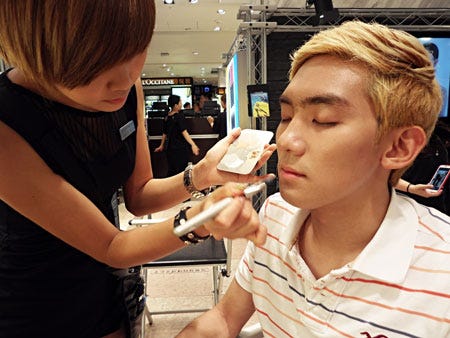
South Korean workers may be the about stressed in the earth and the state's suicide stats trump every nation barring Republic of guyana, particularly for young men. In a social order orbiting around material success, where everyone is competing for the same handful of topflight universities and corporations, male citizens latched onto makeup equally a means to ophidian past the competition. Egged on past cultural pillars like 1000-Pop, the thought of emulating "blossom boys" became "a marker of social success."
Southward Korean companies probably enabled this obsession with pare-deep. Every job application, after all, requires a headshot and many owners adopt having face up-readers on board interviews to determine if an bidder's visage is suitable for their business beyond academics and skills.
Unsurprisingly and then, plastic surgery is commonplace in Republic of korea and an increasing number of men desire Caucasian noses and slim jawlines, while approximately one in five female Seoul-dwellers have gone nether the pocketknife for various procedures. Indeed, long before Psy broke Y'all Tube counters with his monster striking, the urban center's Gangnam district was famous throughout Asia for its strip mall-similar assortment of personal enhancement clinics.
T wo events in the late 1990s reportedly accelerated the upending of traditional masculine ethics in South korea. Starting time, Japanese cultural staples like manga and anime fascinated Koreans after the authorities eased restrictions on their import. Especially popular were the "shoujo" variety targeting teenaged girls where male characters are "bishonen" or "beautiful boys" with exoplanet-sized eyes.

Not long after, the kickoff wave of "blossom boys" crashed onto Korean TV screens courtesy of K-Pop acts like DBSK (aka TVXQ) and later through the super popular local drama "Boys Over Flowers," once again inspired by a Japanese manga. Suddenly, manlike men were passé and elvish imps made women swoon beyond the land.
The Imf Crunch of 1997 besides ostensibly pushed Korean women to rebel confronting male stereotypes. When the downturn hit Due south Korea, female workers were laid off in much higher numbers than their male person colleagues. Since weathering the crunch required a resurgence of nationalism, society expected them to take i for the squad and quietly back up their men.
Nonetheless, Korean women didn't take kindly to this slight and began rejecting the "the ideals of men equally strong, provider types." Coupled with the influence of Japanese comics, the emergence of "flower boys" in advertising and new movies that sold the soft, feminine male, they began pining for partners that were "more interested in satisfying them than their companies."
South uspicious that mainstream media sources were cherry-picking narratives that fabricated Korean men seem kooky, I reached out to my good friend Hyoung Jun Rim in Seoul. Hyoung is a record producer in the thick of all things K-Pop and a professor of music at the Korea Art Conservatory.
He admits that Korean men use makeup on a daily basis, merely improved job prospects are only role of the equation. "It is about competition, but not only for chore interviews." There is a "self-satisfaction" that comes from looking good in the mirror and appealing to the opposite sexual activity, Hyoung says. In curt, a need to preen as human every bit hitting the john, although what constitutes "handsome" in South Korea today might incur homophobic slurs elsewhere.
Hyoung as well doesn't buy the Japanese cultural imports or International monetary fund Crisis theories to explain the shift in masculine standards. Thousand-Pop, he suggests, is a relatively new industry still experimenting with its image and focused solely on making money. Korean boy bands like TVXQ and EXO, for example, are really popular in manga-obsessed Japan, so androgyny could just be a branding strategy.
Seoul may be the male makeup capital of the world, but personally Hyoung nonetheless puzzles over why Due south Koreans are infatuated with waif-similar men wearing heavy cosmetics. He tells me he overhears people enthusing, "That guy'southward caput is sooo small, then handsome!" and merely shakes his head.
If you enjoyed reading this, please login and click "Recommend" below.
This will help to share the story with others.
Follow Cuepoint: Twitter | Facebook

How Do Koreans Feel About Guys Wearing Makeup,
Source: https://medium.com/cuepoint/why-k-pop-has-korean-men-wearing-makeup-21501bd8b0cf
Posted by: garciajacessid.blogspot.com
0 Response to "How Do Koreans Feel About Guys Wearing Makeup"
Post a Comment