

How To Draw A 6 Generation Fan Chart
How to Buy the Right CPU: A Guide for 2021
Choosing the all-time CPU matters a lot, whether y'all're upgrading your existing organisation or edifice a new PC. College clock speeds and cadre counts tin can make a major divergence in performance, providing a snappier organisation, smoother gameplay and faster completion of intensive tasks such every bit video editing and transcoding. Plus, the CPU you choose volition also dictate your motherboard options, equally each processor only works with a specific CPU socket and set of chipsets.
Also, like most aspects of consumer tech, you'll accept to decide to buy the best processor that's available right at present, or wait to see what adjacent-generation fries bring to the table. AMD'due south Ryzen 5000 CPUs are impressive, finally generally overtaking competing Intel CPUs in unmarried- and multi-core operation. But due to a combination of high demand, limited capacity at TSMC'south bit fabs and the ongoing pandemic, AMD'southward latest CPUs have been very hard to discover in stock at or near their MSRPs since launch.
Meanwhile, Intel is about to finally move away from a Skylake-based architecture, with Rocket Lake-S. Intel's new fries promise solid unmarried-core performance gains of their own, every bit well as a sift to a platform that finally supports PCI iv.0 -- a characteristic AMD rolled out in its Ryzen chips about two years agone.

If yous already know a lot about CPU specs and want recommendations, cheque out our picks for best CPUs for gaming and best CPUs for workstations and the best inexpensive CPUs of 2021, tested and ranked. We too have a listing of the best chips on the market according to their CPU Benchmarks. But no matter which desktop processor you get, here are some things to proceed in listen.
TLDR:
- AMD has overtaken Intel (for now): These days, you lot'll often get more for less with an AMD processor, including a overnice in-box cooler (although not with the highest-end Ryzen seven and 9 Ryzen 5000 models) and more cores/threads. Gaming operation has also shifted in favor of AMD for the most part, with the Ryzen 5 5600X overtaking even higher-end Intel CPUs at 1080p and stock settings. And AMD has long handled tasks like video editing faster. Only the 1080p gaming performance edge may shift back to Intel once Rocket Lake-Southward arrives.
- For many tasks, clock speed is more important than cadre count: Higher clock speeds translate to snappier operation in elementary, mutual tasks such as gaming, while more cores will help you lot become through time-consuming workloads faster.
- Upkeep for a full arrangement: Pair a strong CPU with one of the best SSDs, ample RAM and one of the best graphics cards.
AMD or Intel: Which Should You Become?
Up until 2017, AMD was the clear underdog. Simply with its Ryzen / Threadripper series chips, the company has moved steadily toward performance parity with Intel. And with Ryzen 5000 and chips like the Ryzen 5 5600X in particular, AMD has in most respects moved past Intel'southward current offerings, often delivering amend operation in both light and heavy workloads that tax many cores. The matchup may alter substantially though, in one case Intel's latest Rocket Lake-S CPUs make it later in 2021.
All that said, both companies may very capable CPUs. Some fans will have potent opinions, but if y'all don't accept your center assault 1 brand or the other, you lot should be open to either. For much more on this, see our Intel vs AMD: Who Makes the Best CPUs? feature.
What practice you want to do with your CPU?
Information technology's tempting to just spend as much as you lot can afford for a CPU, but you might be better off saving some of your cash for other components. Determine your processor type and max budget based on what you lot demand your reckoner to practice.
- Basic tasks: $fifty-$100 range. If you're only after a chip that will allow yous watch video, browse the Spider web, and exercise bones productivity tasks like word processing and light spreadsheet work, then an entry-level chip with two or four cores might be only what yous need. Just if you often find yourself doing more than one of those basic tasks at once, information technology would be better to step upwardly a model or two. Consider a Ryzen 3, like the AMD Ryzen 3 1300X or AMD Ryzen 3 2200G, or Intel Pentium on the high end of this price range and an Intel Celeron or fries like AMD'south Athlon 200GE on the low cease.
- Gaming: $200-$300 range. If you're primarily interested in high-terminate gaming performance, yous should opt for a mid-range Intel Core i5 or AMD Ryzen five CPU with high clock speeds. Considering that the graphics card is more important for gaming than the processor, you tin save money by not getting a more powerful Core i7 or Ryzen 7 flake.
- Creative media work or overclocking: $300-$400 range. If you desire more cores or speed for things like video editing—or you lot but want a fast, capable system with actress overhead for hereafter computing tasks, splurge on a Ryzen 7 flake.
- Workstation muscle: $400+. If you often find yourself waiting minutes or hours for your electric current system to render your 3D animation or 4K video, or yous're dealing with massive databases and circuitous math, consider an Intel Core X or AMD Threadripper CPU. These beasts offer massive amounts of physical cores (upwardly to 64 every bit of this writing) for extreme multitasking (ex: gaming at high settings while streaming and editing) or time-consuming compute tasks. Business users tin can consider an Intel Xeon (like the contempo Xeon W-3175X) or AMD EPYC processor, only those aren't consumer friendly--or reasonably affordable. For those not quite willing to stride up to multi-grand-dollar CPUs and platforms, AMD's sixteen-core Ryzen 9 5950X or 12-core Ryzen ix 5900X are both excellent alternatives that basically bring workstation-class performance to a mainstream platform.
What generation CPU practice you need?
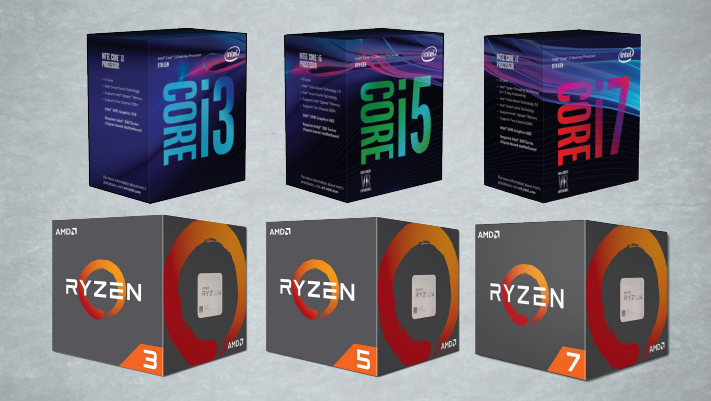
Each year or then, Intel and AMD upgrade their processor lines with a new architecture. Intel is about to launch its "11th Gen Cadre Series," with the Core i9 11900K at the top terminate. AMD's latest fries are office of its Ryzen 5000 line, like the AMD Ryzen v 5600X, Ryzen 7 5800X, and Ryzen 9 3900X. When looking at the model number, yous tin can run across the generation every bit the first digit of the 4 number (ex: the 8 in Cadre i7-8400 or the 3 in Ryzen 7 5700X). Note, though, that AMD skipped 4000 branding on its desktop CPUs.
How do you read the model names and numbers?
The jumble of brands and numbers that brand upwardly a CPU product name can be confusing. Intel and AMD both pause downwards nearly of their fries into "good, better, best" categories, starting with Core i3/Ryzen 3, stepping upward to Core i5/Ryzen 5, Core i7/Ryzen 7, and Core i9/Ryzen nine. Intel has the Core i9-10900K at the top of its mainstream product stack, likewise as extreme/premium tier like the Core i9-10980XE, priced at around $i,000, only every bit AMD has Threadripper. Merely for the vast majority of users, these chips are unnecessary and well out of nigh people's price ranges.
For users on a tight budget, Intel offers its Celeron and Pentium chips (Pentium is slightly faster) while AMD has its Athlon line. On the farthermost high-terminate, you'll find AMD'due south Threadripper and Intel's Core 10 series, forth with the Core X/i9 and Xeon W (both mentioned above).
Now, what nearly the model numbers that come later the three, 5, or vii? The offset digit designates the production generation (Intel'southward Core i7-8700 is an 8th Generation Core processor, and AMD's Ryzen five 2600 is a 2nd Generation Ryzen processor). The rest of the numbers simply marker diverse models in the line, with higher more often than not being meliorate (with more cores and/or higher clocks), while a "1000" at the end of an Intel bit means it's unlocked for overclocking. Merely a scattering of mainstream Intel chips are "K" skus, while nearly all of AMD'southward Ryzen processors are unlocked for overclocking (no "Thou" designation required). An X at the end of AMD model numbers means higher stock clock speeds.
Should you overclock?
Overclocking, the practice of pushing a CPU to its limits by getting it to run at higher-than-specced clock speeds, is an artform that many enthusiasts enjoy practicing. Just, if yous're not in it for the claiming of seeing just how fast you can get your chip to become without crashing, overclocking may not exist worth the fourth dimension or money for the average user.
In order to make your CPU reach significantly higher clock speeds than it is rated for out of the box, you'll probable spend extra on an enhanced cooling organisation and an overclocking-friendly motherboard. While nearly all recent AMD chips are overclockable to some extent, if yous want to punch up an Intel chip, yous'll take to pay extra for one of its K-series processors (which don't come with coolers). By the time you gene in all these extra costs, if you're not shopping about the height of the CPU stack already, you'd be better off budgeting some other $50-$100 (£30-£seventy) for a CPU that comes with higher clock speeds out of the box. And remember, even if you do get all the right equipment, you lot could still go a fleck that doesn't overclock well. Or worse if you don't know what you're doing, you could damage your CPU or shorten its lifespan past pushing also much voltage through it.
What are the key CPU specs and which should I care near?
If you're looking at a spec sheet for a given CPU, you'll come across a lot of numbers. Here's what to look out for.
- Clock speeds: Measured in gigahertz (GHz), this is the speed at which the flake operates, and so college is faster. About modern CPUs adjust their clock speeds upwards or downwardly based on the task and their temperature, and so yous'll see a base of operations (minimum) clock speed and a turbo (maximum) speed listed.
- Cores: These are the processors inside the processor. Mod CPUs take between 2 and 64 cores, with almost processors containing iv to eight. Each 1 is capable of handling its own tasks. In nigh cases these days, you'll want at to the lowest degree four cores--or at least four threads (meet below).
- Threads: This is the number of contained processes a flake can handle at one time, which in theory would be the same equally the number of cores. Nevertheless, many processors have multithreading capability, which allows a single cadre to create two threads. Intel calls this Hyper-Threading and AMD calls it SMT (Simultaneous Multithreading). More threads means ameliorate multitasking and enhanced performance on heavily-threaded apps such as video editors and transcoders.
- TDP: The Thermal Design Contour/Power (TDP) is the maximum amount of heat that a chip generates (or should generate) at stock speeds, equally measured in watts. By knowing that--for example--the Intel Cadre i7-8700K has a TDP of 95 watts, y'all can make sure you take a CPU cooler that tin can handle that amount of estrus dissipation and also that your PSU tin can provide plenty juice. Only notation that CPUs put out significantly more heat when overclocked. It'due south skilful to know what your TDP is so you can get the right cooling and power equipment to support your CPU. Also, a higher TDP usually coincides with faster performance, although things similar process node size and general architecture efficiency come up into play there besides.
- Cache: A processor'south on-board cache is used to speed up admission to data and instructions betwixt your CPU and RAM. There are 3 types of cache: L1 is the fastest, only cramped, L2 is roomier but slower, and L3 is spacious, but insufficiently sluggish. When the data a CPU needs isn't available in any of these places, information technology reaches for the RAM, which is much slower--in part considering information technology'south physically further away than a CPU's on-bit cache.
You shouldn't pay as well much attention to enshroud size, because it's hard to equate to existent-world functioning, and at that place are more important factors to consider.
- IPC: Even if y'all accept two CPUs that have the same clock speed and number of threads, if they're from different companies, or built on unlike architectures from the same company, they will will deliver different levels of IPC (instructions per clock cycle). IPC is heavily dependent on the CPU's architecture, then chips from newer generations (ex: a Ryzen 5 5600X with Zen 3versus a Ryzen seven 2700X with Zen+) will exist better than older ones.
IPC is non ordinarily listed as a spec and is usually measured through criterion testing, so the best way to larn about it is to read our CPU reviews.
What do you need more: clock speed, cores or threads?
The reply to this question really depends on your regular computing tasks. Higher clocks translate to quicker responsiveness and program load times (though RAM and storage speed is key hither also). Higher clock speeds also mean single-threaded tasks (like audio editing and certain older applications) can happen faster. Many pop games are still lightly threaded.
But many modernistic programs tin take advantage of lots of cores and threads. If you do lots of multitasking or edit high-res videos, or do other complex, time-consuming CPU-heavy tasks, yous should prioritize the number of cores. Simply for the vast majority of gamers and full general-purpose estimator users, a clock speed ranging from three-4GHz with iv to eight cores is plenty.
What socket does my motherboard demand for this CPU?
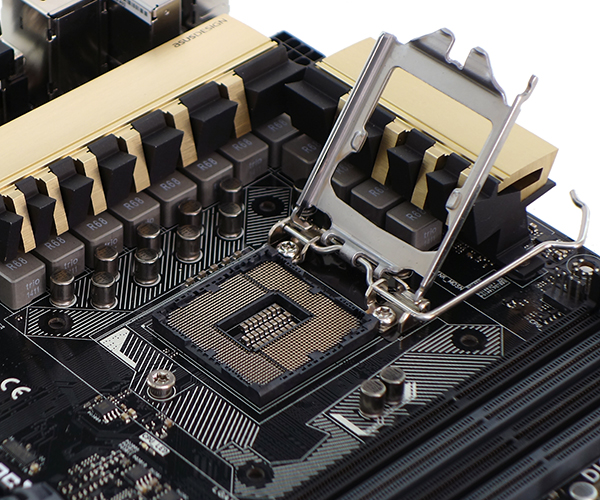
Dissimilar processors require unlike socket types. If you already ain a motherboard and don't want to replace information technology, y'all'll demand to purchase a CPU that matches your board's socket. Alternatively, you need to make certain that the motherboard you buy is compatible with your new processor.
For help choosing a motherboard, see our 2021 motherboard buying guide.
With its current-generation Ryzen and Athlon parts (disallowment Threadripper), AMD has adopted a single socket—AM4. That means you lot should, with a BIOS update, be able to put a current-generation Ryzen chip into prvious-generation Ryzen motherboard, and vice versa. Just due to limitations to the size of bachelor information stored inside BIOS fries and the vast numbers of CPUs AMD has released on AM4, this event has gotten much more complicated lately.
Intel, on the other hand, has a tendency in recent years non to support backward compatibility with its new fries and older motherboards, even if the socket is effectively the aforementioned. For instance, Intel'southward socket LGA 1150 and 1151 differ past a single pivot, and the version of 1551 designed specifically for eighth Generation Core chips is physically the same as that fabricated for previous 6th and seventh Generation Core processors. But those older 1151-socket motherboards don't work with newer 1151-socket CPUs, because (Intel says) the newer chips (which have more than cores) have different power delivery subsystem needs. Notation that Intel has bucked this trend with socket LGA 1200, which will take both tenth Gen Intel and upcoming 11th Gen intel CPUs.
Here's a listing of all the recent mainstream sockets and their respective chipsets for reference.
Socket and Chipset Tabular array
| Intel Mainstream | Intel Mainstream | AMD Mainstream | Intel HEDT | AMD HEDT (Threadripper) | |
| Current CPU Sockets | LGA 1200 | LGA 1151 | AM4 | LGA 2066 | TR4 |
| Compatible Chipsets | Z490/Z590, H470/H570, B460/B560, H410/H510 | Z390, Z370, Z370, Q370, H370, B365, B360, H310 | X570, X470, X370, B550, B450, B350, B450, A320, X300, A300 | X299 | X399 |
Bottom Line
When choosing a CPU, commencement ask what you're going to do with it, and so meet how much you tin can budget for information technology after you lot've figured out how much y'all're spending on other components. Cheque our All-time SSDs, Best RAM, Best Graphics Cards and Best Power Supplies guides for more details. While processors are of import, in that location's no point in pairing a high-speed bit with weak graphics (unless yous aren't a gamer) or a slow, spinning mechanical hard bulldoze. While reading most specs like clock speed and thread count is helpful, the best measure of a processor's performance comes from objective reviews, like those we write hither on Tom's Hardware.
More than: CPU Benchmarks Hierarchy
MORE: All CPU Reviews
MORE: How to Cull a Motherboard
More: How to Sell Your Used PC Components

Source: https://www.tomshardware.com/reviews/cpu-buying-guide,5643.html
Posted by: garciajacessid.blogspot.com
0 Response to "How To Draw A 6 Generation Fan Chart"
Post a Comment